Advanced Pharmaceutics: Innovative Drug Delivery Systems, Nanomedicine, and Translational Perspectives
Keywords:
- Pharmaceutics; Drug Delivery Systems; Nanomedicine; Lipid Nanoparticles; MRNA Delivery; 3D Printing; Microneedles; Translational Medicine; Regulatory Science
Abstract
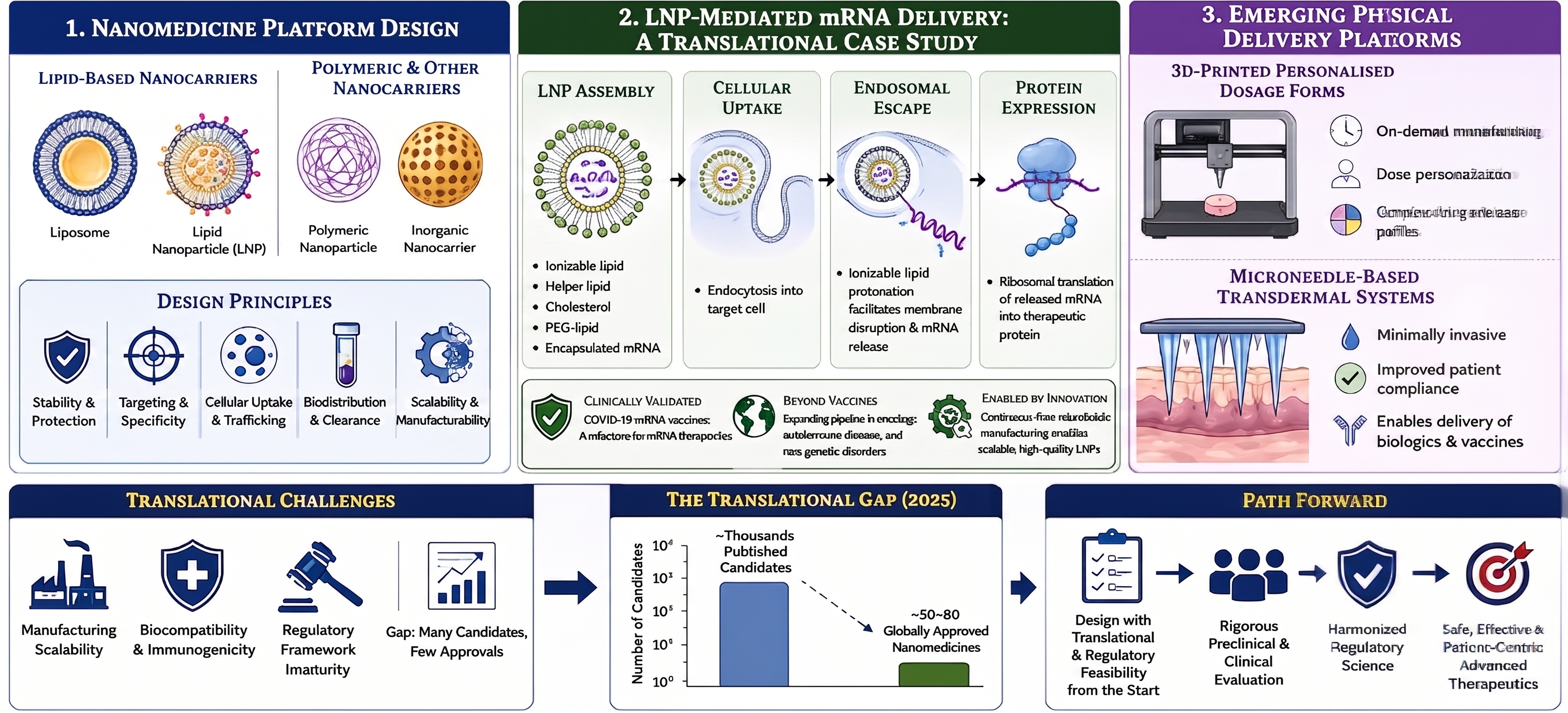
Advanced pharmaceutics has progressively shifted from conventional oral and parenteral formulations to engineered delivery platforms that protect labile therapeutics, enable site-specific targeting, and enable entirely new therapeutic modalities. This review surveys three convergent areas that define the field's current state. First, we examine nanomedicine platform design, focusing on lipid-based nanocarriers liposomes and lipid nanoparticles (LNPs) and polymeric and other nanocarrier systems, and the physicochemical design principles that govern their stability, biodistribution, and cellular uptake. Second, we present LNP-mediated messenger RNA (mRNA) delivery as a detailed translational case study, tracing the platform's evolution from a longstanding nucleic-acid-delivery bottleneck to a clinically validated technology underpinning approved COVID-19 vaccines and an expanding pipeline of oncology, autoimmune, and rare-disease therapeutics. Third, we survey emerging physical delivery platforms, including three-dimensional (3D) printed personalised dosage forms and microneedle-based transdermal systems, that extend precision pharmaceutics beyond nanoparticle formulation to on-demand, patient-specific manufacturing. Across all three areas, we critically examine the persistent gap between the very large number of published nanomedicine and advanced delivery candidates and the substantially smaller number that have achieved regulatory approval, and we identify manufacturing scalability, biocompatibility and immunogenicity, and regulatory framework immaturity as the principal barriers constraining this translational pipeline. We conclude that continued progress in advanced pharmaceutics will depend on treating translational and regulatory feasibility as a design criterion from the earliest stages of platform development, rather than as a downstream consideration addressed only after formulation optimisation is complete.
Downloads
References