Budd-Chiari Syndrome with Complete Hepatic Vein Obliteration Successfully Decompressed by Direct Intrahepatic Portosystemic Shunt and Complicated by Hepatic Encephalopathy: A Case Report
Keywords:
- Budd-Chiari syndrome; hepatic venous outflow obstruction; direct intrahepatic portosystemic shunt; DIPS; portal hypertension; refractory ascites; hepatic encephalopathy; acute kidney injury; hepatic-vein thrombosis.
Abstract
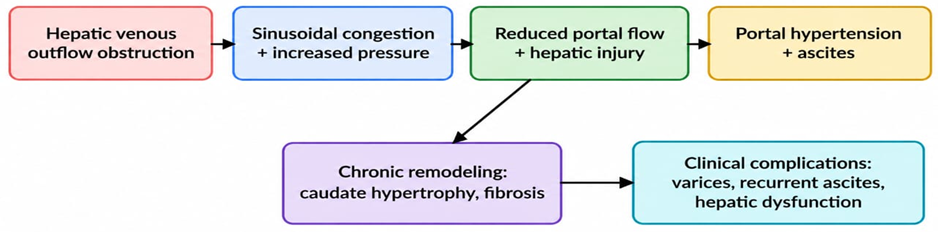
Budd-Chiari syndrome (BCS) is an uncommon vascular liver disorder characterized by obstruction of hepatic venous outflow in the absence of a primary cardiac or pericardial cause. The resulting sinusoidal congestion and portal hypertension may produce abdominal pain, hepatomegaly, ascites, variceal formation, hepatic dysfunction, and, in advanced disease, liver failure. Management is individualized according to the anatomical pattern, severity of hepatic dysfunction, and response to treatment and may involve anticoagulation, endovascular recanalization, portosystemic shunting, and liver transplantation ¹-³. A 20-year-old woman presented with abdominal pain, progressive abdominal distension, gross ascites, and bilateral pedal edema. Contrast-enhanced computed tomography demonstrated caudate-lobe hypertrophy with compression of the intrahepatic inferior vena cava (IVC), prominent hepatic arteries, heterogeneous mosaic hepatic enhancement, complete obliteration of the hepatic veins, and marked ascites. Upper gastrointestinal endoscopy demonstrated grade II esophageal varices. Recurrent tense ascites required ultrasound-guided therapeutic paracentesis, with approximately 6 L of ascitic fluid removed and subsequent intravenous albumin administration. Because of persistent portal-hypertensive complications and complete chronic hepatic-vein occlusion, direct intrahepatic portosystemic shunt (DIPS) was performed on 31 July 2026. Conventional hepatic-vein access was not feasible because the hepatic veins were completely obliterated. A direct portal-vein-to-IVC tract was therefore created and treated with a partly covered stent. Completion portography demonstrated brisk flow through the shunt into the IVC. The patient was discharged in a hemodynamically stable condition on 5 August 2026 with anticoagulation and supportive therapy. She subsequently required readmission with altered sensorium. Hepatic encephalopathy was diagnosed in the setting of a serum ammonia concentration of approximately 106.7 µg/dL. The subsequent critical-care course was complicated by acute kidney injury, requiring renal supportive management including a documented hemodialysis session and mechanical ventilatory support. This case demonstrated the role of DIPS as an anatomy-directed portosystemic decompression strategy in severe BCS when complete hepatic-vein obliteration makes conventional hepatic-vein-based TIPS technically difficult or impossible. It also illustrates an important complication of portosystemic shunting-hepatic encephalopathy, and emphasizes the need for intensive post-procedural surveillance of neurological status, renal function, hepatic function, anticoagulation, and shunt patency.
Downloads
References