Development, In-Vitro Release and Accelerated Stability of a Topical Gel Containing Arbutin– and Ascorbic Acid–Phosphatidylcholine Complexes
Keywords:
- Arbutin; Ascorbic Acid; Phosphatidylcholine; Carbopol Gel; Franz Diffusion Cell; Higuchi Model; Stability; Hyperpigmentation
Abstract
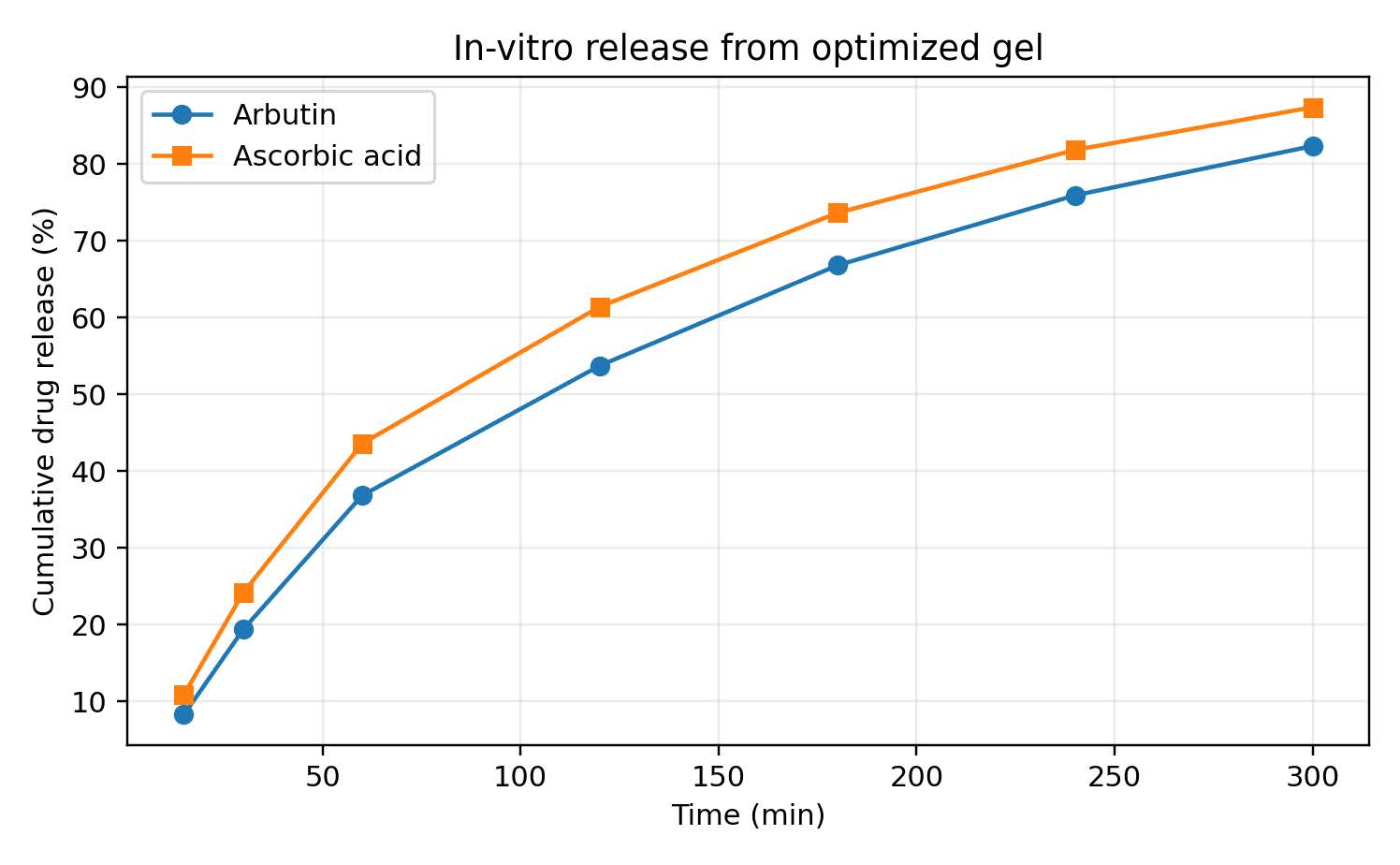
Background: Arbutin and ascorbic acid are hydrophilic skin-lightening phytopharmaceuticals with limited passive penetration through the stratum corneum. Objective: To formulate a Carbopol 934 gel containing optimized phosphatidylcholine (PC) complexes of both actives and evaluate physicochemical properties, simultaneous UV assay, in-vitro release kinetics and accelerated stability. Methods: Optimized arbutin-PC and ascorbic acid-PC dispersions (20 mL each) were incorporated into a 50 mL Carbopol 934 gel. The formulation was assessed for appearance, spreadability, pH, viscosity, assay, Franz-cell release and six-month stability at 40 ± 2°C/75 ± 5% RH. Results: The gel was homogeneous, with spreadability 6.82 ± 0.18 cm, pH 5.48 ± 0.06 and viscosity 12,460 ± 185 cP in the primary evaluation. Drug content was 98.92 ± 0.46% for arbutin and 98.32 ± 0.57% for ascorbic acid. At 300 min, cumulative release reached 82.37 ± 2.38% and 87.42 ± 2.46%, respectively. Higuchi modelling gave the highest R² values (0.9971 and 0.9980). During accelerated storage, drug content remained 97.76 ± 0.61% and 96.84 ± 0.69% at six months, with no significant visual change. Conclusion: The dual-PC complex gel showed suitable topical properties, high assay, diffusion-controlled release and acceptable accelerated stability
Downloads
References